Saturday, May 10, 2014

Checking in on the Aluminum Plant


A few weeks ago I moved my aluminum plant from a shelf next to an east-facing window down to the window's sill where it got some direct sunlight in the morning.  I moved it because I was a little concerned that it wasn't getting enough light as the new growth seemed to have stunted.  I don't know if it was coincidental timing or if the light actually helped, but in the past few days this thing seems to have really taken off!

April 2014:


May 2014:


Propagating Wandering Jew

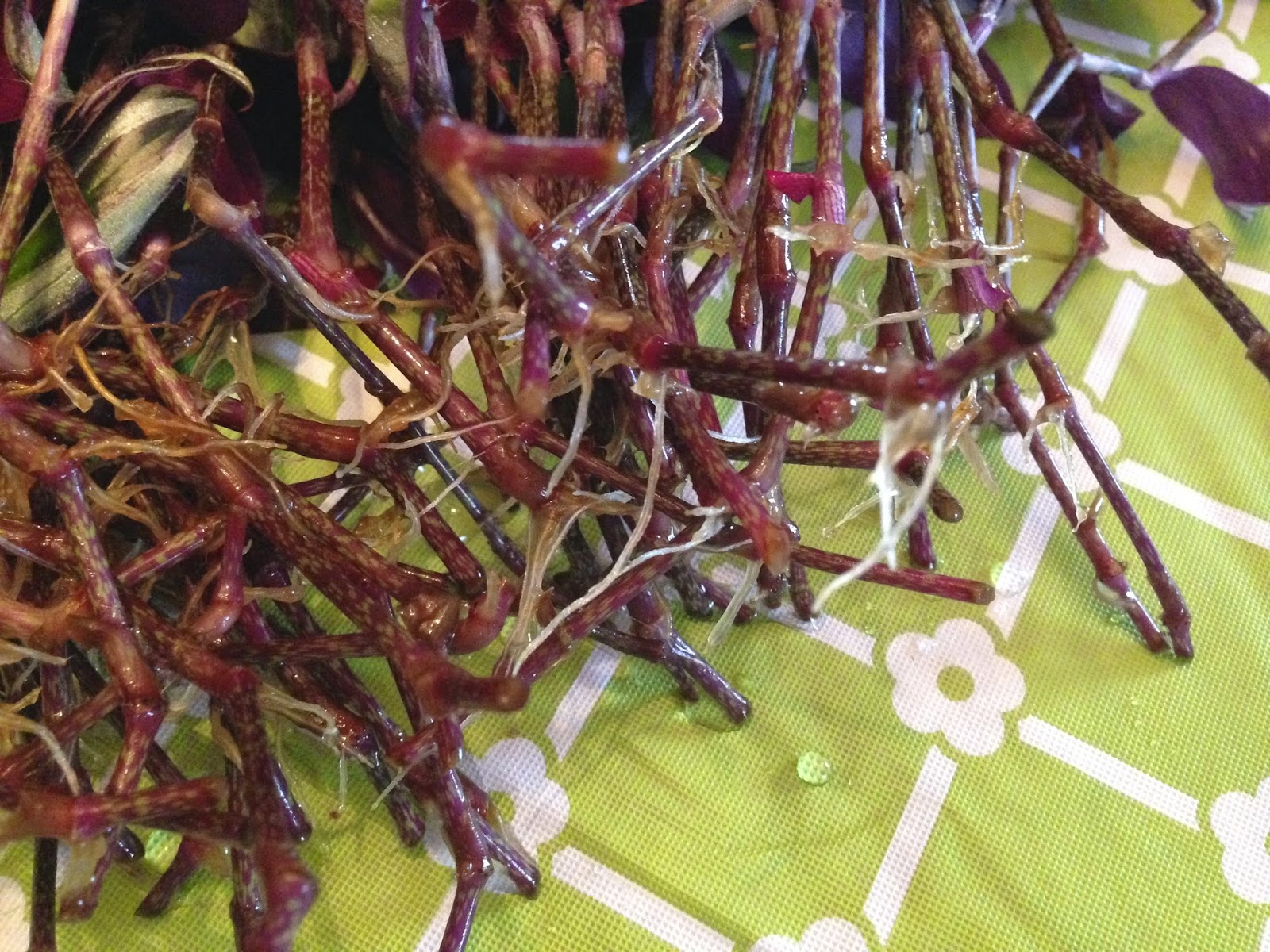
Today I finally took my rooting cuttings of the wandering jew I recently incarnated into the next generation.  Here you can see the 50 or so cuttings I'd had soaking in a short vase of water, developing roots.


All but maybe 3 of them had a decent start to a root system.


And here is their new home:


 I planted them in 4 groups, bunching them up in my hand, boring a little hole and shoving them down in.  There's probably 14 or so in each group.  I have found that planting a whole mess together like this yields a much fuller and hearty looking plant.  I used to plant them stem by stem in a spread out configuration that led to leggy looking adult plants.


Since I was reusing potting soil, I added a scoop of vermiculite and pearlite, mixed it around a little bit with the soil and sprinkled maybe an inch on top of the pot of reused soil.  I read somewhere that it is good to reuse soil for new plants, new soil may "shock" them.  I also doused the new potting with a full flush of 15-30-15 fertilizer in rainwater.


I'll report back in a few weeks to let you know how many have taken root and how it's growing!

African Violet (Saintpaulias)

My understanding is that these plants are long-term bloomers, close in decoration value to an orchid.  I got this one already in bloom.  I originally had it in an east-facing room where it received perhaps an hour of direct sunlight from a west-facing window in an adjacent room.  It started to lose a lot of its blooms so I wasn't sure if this was from not enough sunlight or perhaps not enough watering.  So I took it out of that darker space and put it on a west-facing window sill.  There haven't been any new blooms but it seems to be doing well.  I think the plant likes humidity so I am trying to keep it pretty moist.

March 2014:


May 2014:


I have also read that if you get water on the leaves and don't wipe it off, it will create brown spots that never repair.  So far I seem to have kept all the water in the soil, though, admittedly I don't really take care when watering!

1.) Propagate: Divide during repotting or grown from leaf cuttings.
2.) Water: Keep soil moist but not soggy.
3.) Light: Moderate to bright indirect light.
4.) Fertilize:
5.) Soil:  

Rex Begonia

Though I have heard of them often before, I don't really know much about Begonias.  I bought this one because I liked the rich deep colors in the leaves.  I'm not sure if this will ever flower, but I'm hoping to keep it alive long enough to get it through a growth and dormant cycle, i.e. at least a year.

Here it is when it first joined the ranks end of March 2014:


Here it is today, May 10, 2014:


It looks like it has grown, but it could just be the angle.  One side has way more leaves than the other.  For example, this side looks less lush, right?


Anyway, some basic stats on this bad boy...

1.) Propagate: From leaf cuttings or dividing while repotting
2.) Water: Regularly, but do not over water.  They like humidity but not misting.
3.) Light: Bright indirect light.
4.) Fertilize:
5.) Soil: Light and fast-draining.

Monday, May 5, 2014

Braided Umbrella Tree (Schefflera Arboricola)

This was one of my earliest experiments in botanical babes.  I received it March 2012 and it was stowed in a room that received a lot of hot evening western sun.  It originally had three separate trunks and was very full, as you can see in the first photo.

March 2012:


I'm not sure if it was the heat or if it was the gnat-like bugs that accumulated in this warm room, but there was significant leaf drop.  It would happen to one trunk at a time.  The first trunk started dropping leaves, probably one cluster per day.  When no leaves were left, the trunk would turn black and ultimately it pulled out with barely even a tug!  When this started to happen to the second trunk, I hung some bug traps and caught almost all of the gnats, and moved the plant to a more climate-controlled room with comparable light.  It was too late to save the second trunk, but this maneuver managed to spare the third trunk.

March 2013:


After about a year I realized that the density of the foliage could only improve with additional trunks, as was the intent of the original clustering.  So I tried to propagate.  I had read that you can snip off a short segment from the top, stick it in rooting hormones and water, and roots will emerge after a week or two.  I waited over a month and still no roots emerged.  I ended up tossing the top clipping because it started to stink.

I had held off trying this technique because I worried this would stunt the original main trunk.  However, as you can see in the images below, a new trunk shoot has sprouted out near to where the old top had been clipped.

November 2013, before clipping:


November 2013, after clipping:


May 2014, new sprout growth:


Sunday, May 4, 2014

Sedum (Nussbaumerianum)

I do not have any investigation into this plant yet, but it seems to be growing well with my default method of plant care. I water it thoroughly about once a week in a similar style to the other succulents.

September 2013:


April 2014:


As you can see it seems to be growing! I put the terracota pot in this glazed one in lieu of keeping it on the stone covered tray.

EDIT

I have discovered that the scientific name for this plant is Nussbaumerianum.  It takes on copper tones, which at first I thought was a sign of getting too much sun!  I'm still not sure the proper way to care for this one.  However, my propagations seem to be doing swell.

Saturday, May 3, 2014

Aluminum Plant (Pilea cadierei)

I bought these plants probably because they were on sale and definitely because I needed something to fill a new little red container I had just acquired.  Also, I was at a point in my life when I needed something new and fun.  I had never heard of them before or seen them, to my recollection.  I potted them with generic potting soil along with this polka dot plant I got at the same time, September 2013.


While the polka dot plant took off, these two aluminums didn't do so hot.  After I repotted the polka dot plant in its own habitat, since it had gotten too large for this container, I moved the aluminums each to their own pots.


Shortly after this repotting in late fall early winter, I lost one - the leaves turned brown, shriveled and fell off until all I was left with was a stump.  The second lost some leaves in the same way, but I've managed to keep it alive.

April 2014 (you can see some browned tips on all the leaves, I can't figure out what this is from yet):


Here are some stats I found on this rascal.

1.) Propagate: cuttings set in water until roots form.
2.) Water: keep moist during the growing season, let dry out during the winter months.
3.) Light: bright indirect light
4.) Fertilize: standard balanced fertilizer, every 2 weeks in the growing months
5.) Soil: sandy soil mixture